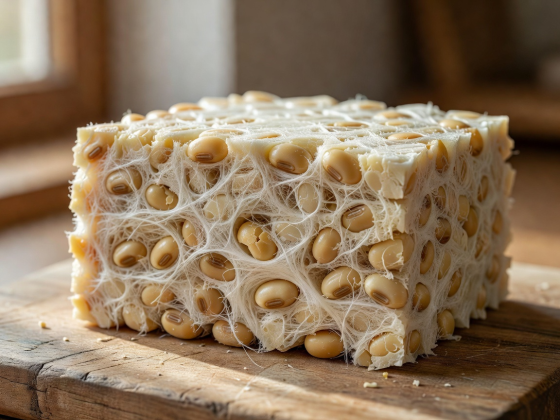
1. Biology of Rhizopus Oligosporus
Originally developed in Java, Indonesia, tempeh is a solid-state fermentation wherein individual cooked legumes (classically soybeans, but equally effective with chickpeas, quinoa, and split peas) are knitted into a compact solid cake by dense hyphal filaments of the zygomycete fungus Rhizopus oligosporus (or Rhizopus oryzae).
During its rapid 36-hour growth cycle, the fungus produces strong proteases, lipases, and phytases. It breaks down indigestible oligosaccharides (such as stachyose and raffinose that cause gastrointestinal distress) while increasing free amino acid content by over 300%.
2. Critical Protocol Checkpoints
- Dehulling & Acidification: Soybeans must be split and dehulled so fungal hyphae can penetrate the cotyledon meat. Adding 15ml of 5% apple cider vinegar per 500g of dry beans during cooking drops substrate pH to ~4.8, arresting heat-resistant bacterial spores such as Bacillus cereus.
- Surface Drying (Non-negotiable): After boiling, beans must be drained and towel-dried with a fan until the exterior seed coat is completely free of free standing moisture. Wet beans will develop slimy anaerobic bacterial rot instead of fuzzy white mycelium.
- Perforated Aeration: Pack inoculated beans into food-grade bags or banana leaves perforated with needle pricks spaced every 1.5 cm. The mold requires moderate oxygen to respirate, but excessive air will cause premature grey sporulation (sporangia release).
The Exothermic Peak Warning: Between hour 18 and hour 28, the mold enters an aggressive metabolic phase, generating substantial internal heat. If the ambient incubator is set at 31°C, the bean internal core can surge to over 38°C, which will sterilize the mycelium. Always reduce incubator temperature or increase air circulation during mid-ferment.