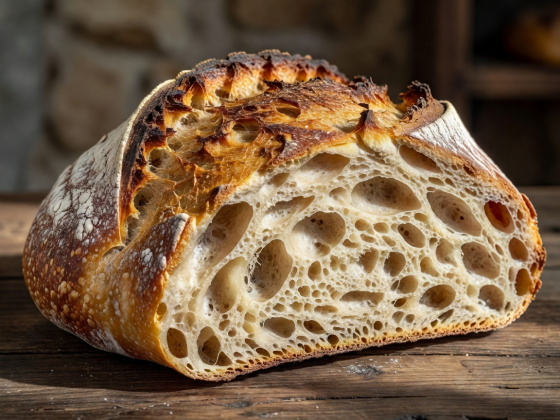
1. The Microbial Mutualism of Sourdough
A mature wild sourdough mother starter is home to a staggering 100:1 ratio of lactic acid bacteria to wild yeast cells. The most famous ecological pair is Fructilactobacillus sanfranciscensis and Kazachstania exigua (formerly Saccharomyces exiguus).
Unlike commercial brewer's yeast (Saccharomyces cerevisiae), Kazachstania exigua cannot metabolize maltose sugar. Meanwhile, F. sanfranciscensis requires maltose for energy and releases glucose into the environment. This elegant metabolic partition prevents the two species from competing for carbon sources, allowing them to coexist in high-density harmony for decades.
2. Balancing Lactic vs. Acetic Acid
The flavor profile of your loaf—whether mildly sweet and creamy or intensely tangy and sour—depends strictly on how you manipulate hydration, temperature, and feeding frequency:
- Lactic Acid Dominance (Creamy, buttery, mild): Achieved by maintaining high levain hydration (100% to 120%) and warm fermentation temperatures (26°C to 29°C). Homofermentative lactobacilli flourish in wetter, warmer environments.
- Acetic Acid Dominance (Tangy, vinegar-like, robust): Achieved with stiff levains (50% to 65% hydration) and cold retarded proofs (4°C to 8°C for 16-24 hours). Heterofermentative bacteria produce more volatile acetic acid under colder, drier stresses.
3. 7-Day Wild Starter Creation Schedule
| Day | Action & Flour Mix | Water (24°C) | Observation |
|---|---|---|---|
| Day 1 | 50g Whole Grain Rye Flour | 50g | Initial colonization of epiphytic wild bacteria |
| Day 2 | Discard half (keep 50g), add 50g unbleached bread flour | 50g | Slight bubbling, bacterial battle begins |
| Day 3 | Keep 50g, feed 50g flour (50/50 rye & white) | 50g | False rise due to Leuconostoc; sharp acetone smell |
| Day 4 | Keep 50g, feed 50g bread flour | 50g | pH drops below 4.5; true LAB and yeasts awaken |
| Day 5-6 | Transition to 12-hour feeding intervals | 50g | Starter reliably doubles in volume in 4-6 hours |
| Day 7 | Ready to bake (Passed float test) | 50g | Pleasant fruity, yogurty aroma, domed spongy peak |
4. Phytate Breakdown & Bio-availability
One of the profound health benefits of long-fermentation wild sourdough is the activation of the endogenous phytase enzyme in whole grains. At a starter pH of 4.5 to 5.5, phytase degrades phytic acid (an anti-nutrient that binds to iron, zinc, and magnesium), unlocking minerals for superior human gastrointestinal absorption.