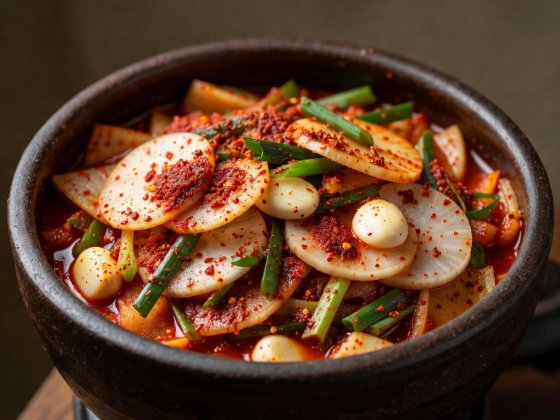
1. The Heterofermentative Succession Model
Traditional Korean Baechu Kimchi (배추김치) is not driven by a single organism, but by a delicate chronological succession of lactic acid bacteria (LAB). Understanding this succession allows the fermenter to achieve optimal carbon dioxide production, bright effervescence, and clean lactic acidity without bitter acetic notes.
During the primary stage (Days 1–3 at 18°C–21°C), Leuconostoc mesenteroides dominates the anaerobic environment. As a heterofermentative bacterium, it produces lactic acid, acetic acid, ethanol, and large volumes of CO2 gas. This natural carbonation forces oxygen out of the jar and generates the characteristic sparkling mouthfeel of pristine young kimchi.
2. Master Formula & Salting Dynamics
The salinity of the cabbage prior to seasoning paste application must land strictly between 2.0% and 2.5%. Too little salt (<1.5%) encourages soft-rot pectinolytic bacteria such as Erwinia carotovora, while excessive salt (>3.5%) suppresses beneficial LAB, stalling fermentation.
| Phase | Target Temperature | Target pH Range | Dominant Microflora |
|---|---|---|---|
| Initial Salting (Brine Bath) | 18°C – 22°C | 6.2 – 6.5 | Natural epiphytic flora suppressed |
| Early Fermentation (Days 1-3) | 18°C – 20°C | 5.2 – 4.5 | Leuconostoc mesenteroides (Heterofermentative) |
| Peak Ripening (Days 4-8) | 15°C – 18°C | 4.4 – 4.1 | Lactobacillus plantarum, L. brevis |
| Cold Maturation (Months 1-6) | 1°C – 4°C | 3.9 – 4.1 | Lactobacillus sakei, Weissella koreensis |
3. Step-by-Step Production Protocol
- Quartering & Brining: Slit Napa cabbages lengthwise. Immerse in a 10% brine solution for 6 to 8 hours until stems bend without snapping. Rinse thoroughly three times in cold water and drain upside down for 2 hours to eliminate excess water.
- The Porridge Paste Base: Whisk 25g sweet rice flour into 350ml water over low heat until translucent. Stir in 20g unrefined cane sugar. Allow to cool completely to room temperature (vital so high heat does not kill raw aromatics).
- Seasoning Integration: Combine the rice paste with 90g Korean coarse gochugaru flakes, 45g minced raw garlic, 15g finely grated ginger, 40ml raw fermented fish sauce (or seaweed-shiitake broth), and 1 finely julienned Mu radish.
- Packing & Anaerobic Seal: Rub each leaf thoroughly with paste. Pack tightly into a sanitized fermentation crock or latching glass jar, pressing firmly down to expel air pockets. Ensure 2 inches of headspace for expansion.
4. Troubleshooting Guide
If your kimchi develops a white surface film, this is almost always Kahm yeast (wild aerobic yeasts) forming due to oxygen exposure. Skim the film away immediately, sanitize the rim with food-grade alcohol, and submerge the vegetable matter under the brine with a sanitized glass weight.